
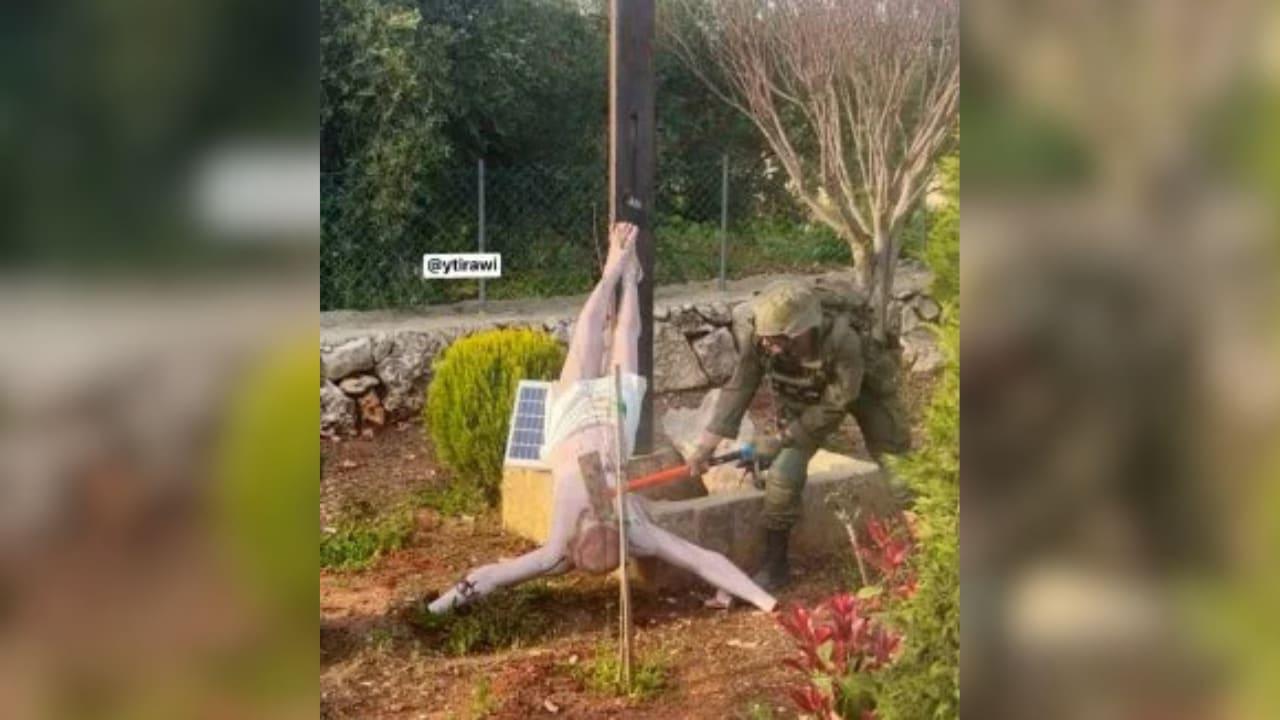
Nabd ElHaya - An incident involving the destruction of a statue of Jesus Christ in the Christian town of Debel, in southern Lebanon has drawn renewed attention to the sensitive issue of the protection of Christian religious symbols in areas affected by armed conflict, and the extent to which sacred sites and imagery are safeguarded in volatile and militarized environments.
Widely circulated footage on social media platforms appears to show an Israeli soldier striking and destroying the statue with a heavy hammer. The image later prompted official attention, with The Jerusalem Post reporting that the Israeli military considered the photograph “authentic” in terms of its visual source and announced the opening of an internal investigation. The military further stated that the soldier’s conduct “does not align with military values” and that disciplinary measures would be taken based on the findings.
The incident has since taken on a broader symbolic dimension beyond its immediate military context, largely due to its association with an image of Jesus Christ in a region deeply embedded in the historical and religious memory of Middle Eastern Christian communities.
Within Christian discourse in the region, the incident is not viewed in isolation, but rather as part of a wider pattern of concerns regarding the treatment of religious symbols in conflict settings. It is often referenced alongside a series of reported and documented incidents that, collectively, raise recurring questions about respect for sacred sites and religious sensitivities in areas marked by prolonged instability.
Official Israeli explanations and statements have not significantly reduced these concerns within segments of Christian and Muslim discourse, where such incidents are often interpreted within a broader climate of ongoing tension affecting religious sensitivities across historic Palestine and parts of the Levant.
From a local Christian perspective, the incident is understood within a wider framework of daily friction affecting Christian presence in the Holy Land. Church and human rights institutions have documented a range of sporadic incidents in recent years, including reported acts of provocation or harassment in proximity to religious sites, such as spitting on Christian clergy during religious processions in Jerusalem, restrictions on access in and around the Old City, and damage to Christian-owned property or religiously significant locations in certain areas.
In the West Bank, local and church sources describe a gradual increase in pressures on a number of Palestinian towns and villages in recent years, including areas with a long-established Christian presence such as Taybeh, east of Ramallah. These sources report incidents affecting agricultural land and residential outskirts, as well as cases of property damage, including burned vehicles and agricultural assets, in addition to recurring confrontations with settler groups operating in nearby areas.
At the same time, residents point to the broader impact of military infrastructure measures across the West Bank, including checkpoints and iron gates that restrict movement between villages and cities. These restrictions affect access to employment, healthcare, and essential services, contributing to a growing sense of geographic fragmentation and daily hardship for local communities.
Taken together, these conditions are described as part of a complex and prolonged environment of tension that continues to shape the social and economic realities of affected populations, marked by uncertainty and repeated friction at multiple levels.
In this context, these developments are not perceived as isolated incidents, but rather as part of a wider and persistent pattern of instability affecting Palestinians in general, and Palestinian Christians in particular, who remain an integral component of the historical, cultural, and religious fabric of the Holy Land rather than a marginal or incidental presence.
The incident, in its symbolic and human dimension, raises broader questions about the relationship between military force and religious symbols in conflict zones, and about the effectiveness of institutional and ethical safeguards designed to protect sacred sites, ensuring they remain outside the dynamics of political and military confrontation and within a shared spiritual and human space.